It’s been three weeks since the last time I posted here. I’ve been waiting for something exciting to happen, and finally gave up.
Every day here is like Groundhog Day. We wake up at 6:30ish AM, depending on how many times I hit the snooze button in my phone. I spend 40 minutes psyching myself up to do a 30 minute calisthenics workout in the living room; we shower and eat breakfast; then walk to the office.
At the office, we do various clerical and planning tasks all morning; then usually walk up the lane from our office to eat local food for lunch (lentils, rice and greens) at “the canteen”; then it’s back to the office, where we work all afternoon doing more of the same. I have started taking a break to practice a few of the new church hymns on the piano in the chapel upstairs, when I can fit that in.
We leave to walk home between 4:30 and 6:00 PM, and once there, if we have the time and energy to take a walk, we switch gears and walk 3-4 miles along some trafficy polluted streets, before heading home to spend 2-3 hours preparing and cleaning up from dinner. And finally we have time to goof off, but sadly, there is very little time left for that. This is our life, right now. No bike rides. No hikes. No movies or TV shows. No sporting events. No theater. Just back office work.
In my last post, I think I promised to talk about learning to drive here. When we arrived,Kenya, there was a nice white Isuzu 4×4 diesel truck with a camper shell awaiting one of us to get qualified to drive it. James was happy to ride along as a perpetual passenger with the Stowells, but I was dying to be able to go to the store and do what I want to do, when I want to, which you cannot do, when you rely on other people for rides. So I stepped up to take the reigns of that Isuzu truck, which required filling out some forms, doing some online and hands on training and getting my driving record checked out. Thankfully, my driving record passed the muster, because I was starting to get cabin fever.
Let me just say that learning to drive on the left side of the road, from the right side of the vehicle, in traffic like nothing you have seen in your entire life, is not easy. If you’ve ever been in a large Middle Eastern or African city, you have some familiarity with the kind of traffic and driving we deal with here. For the locals, traffic laws are just suggestions. Lane lines on roads mean nothing. There is no such thing as “right-of-way”. Pedestrians have no rights. Boda Bodas (the motor bikes that carry people and cargo) and matatus (beat up people moving mini-vans packed with up to 20 people) rule the road, pull in and out of traffic and drive down the wrong side of the road at their whim. Bottom line: White haired little old ladies like me don’t stand a chance.

James and I ventured out alone for for the first time one Saturday morning, on the tail end of the holidays, when the traffic was nice and light. Having planned a little excursion to the closest China Square, we picked the route option with the fewest traffic circles. Even with the best possible driving conditions, the entire experience blew my mind. Keeping the car in the lane and not side swiping pedestrians and other vehicles on my left was harder than you might think, when you’re driving position is reversed. Remembering to look the right direction for cross traffic, when making turns; turning into the correct lane when making a turn; even just using the correct lever to signal a turn (sounds easy, but it takes some time to adapt to the fact that the lever you’ve been using your entire life now turns on the windshield wipers, and the turn signal lever is on the right)—really, just everything about driving was a killer challenge at first.

In this city of over 6 million people, the primary traffic control mechanism is (wait for it) traffic circles. Imagine a traffic circle at the busiest intersection you know off—one with 12 or 16 lanes of traffic merging from 4 sides of the circle and crossing from the outside to the inside and back to the outside of the circle, while a hundred other cars are also making the same moves in the opposite directions from all angles. It’s each man for himself, and if anyone hesitates and leaves even the smallest gap, one or more boda bodas will buzz in and fill the gap. In fact boda bodas are circling the cars from all sides, creating hazards and distractions all at the same time.
The more I have driven, the easier it has become. A few of our trips are mostly low stress, because we can just get on a lightly used toll road expressway for the majority of the trip, but once off the expressway, pedestrians and boda bodas darting into traffic from both sides of the road unnerve me every time.
There are some silver linings here. The Temple is one. It is a sacred place, so it is always good to be there, just as it is when we’re home in Gilbert. But here, it is full of young people, with very few people there who are our age, besides the temple presidency, their wives, and (ahem) us. Church meetings are the same—mostly young people and young families, with a handful of older folks.The membership of our church in Africa is very young, and these young folk are the future of the church on this continent. It is good to see them step up in church meetings and classes, and the institute program is hopping with activity.
And occasionally, the Western World makes an appearance here. On January 28th, Derrick Porter, the current producer/writer/presenter of the Music and the Spoken Word broadcast came to Africa for the first time and picked Nairobi for a broadcast and devotional. The chapel adjacent to our offices was selected for the broadcast, as it is the largest chapel in Nairobi. Five church choirs from around Nairobi ramped up their rehearsals to prepare to perform, including one from the Mully Children’s Family orphanage (my favorite). It was a very long evening, with just a couple of the choirs being lively and entertaining, but it was fun to connect with friends we have met since we arrived here, and I may have enjoyed a nap or two.

Here is a short clip of the Mully Children’s Family Choir. They were non stop loud, but fun to listen to.
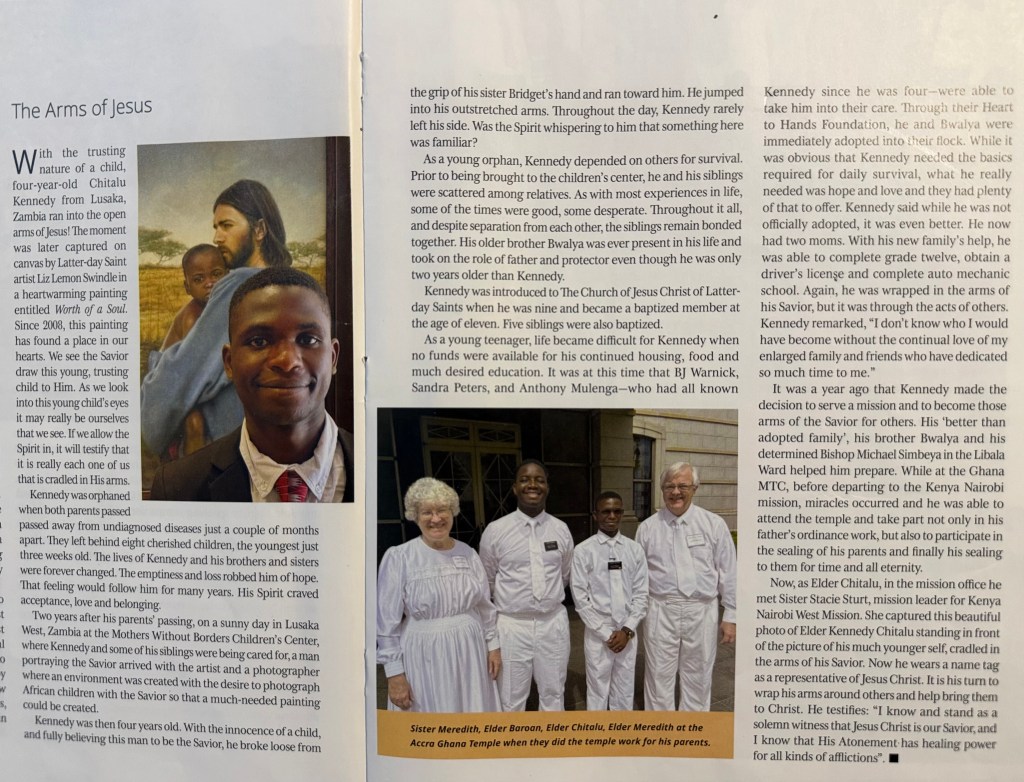
Any time the missionaries drop by our office, we stop what we’re doing and take a break to chat with them. From them, we hear some great stories, funny stories and a few sad stories. One such missionary is Elder Chitalu, who, as a young orphan, was chosen off the street to pose for an original painting of Christ holding a child in his arms. The painting hangs in our office and our apartment. One day when he dropped in the office, he offered to tell me the story of the painting, but I told him I had just read the Liahona article I have posted below. He informed me that the article tells the story better than he does. Be sure to zoom in and read about this bright, inspiring and humble young man. Meeting him has been one of the highlights of my mission.

Back in Arizona, Christine Johnson, a dear friend from our Ward in Gilbert, who was just in her 50s, died a couple of weeks ago, after struggling for about 14 months with a persistent cough that prevented her from sleeping, eating and getting out and about. She was an exceptional person, and was dearly loved by legions of nieces, nephews, siblings, in-laws, friends, and of course her parents, who cared for her tenderly for many years. W
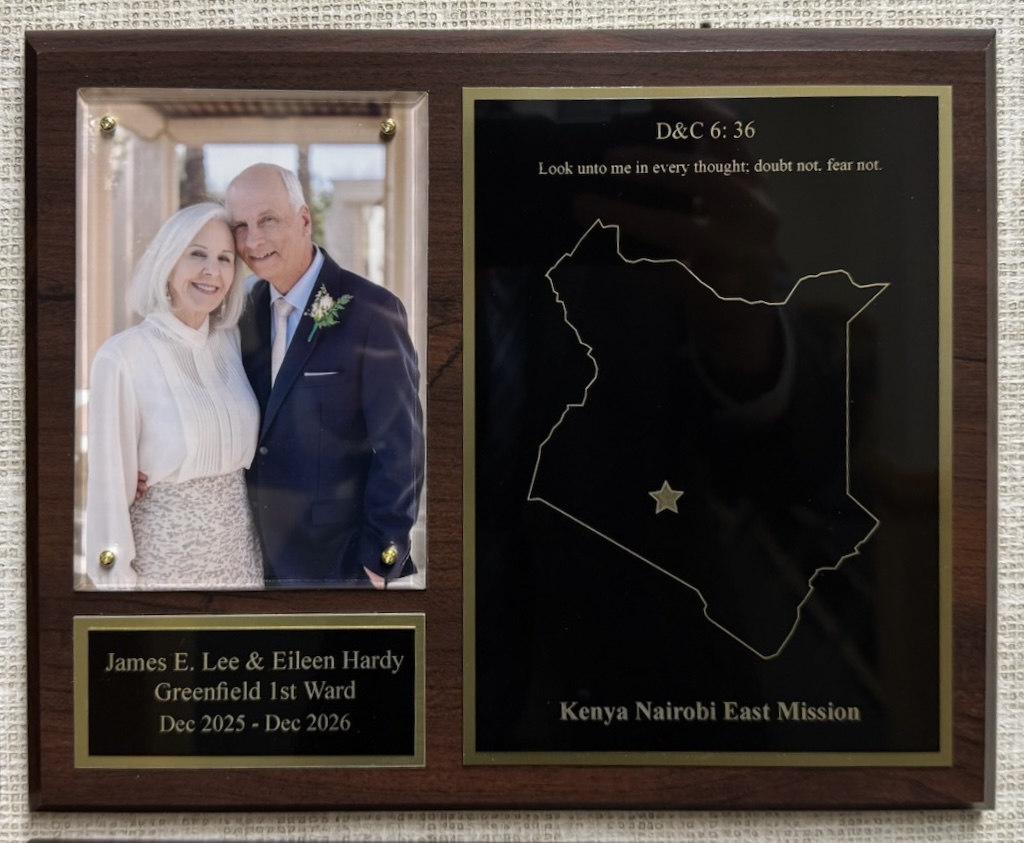
We had just been asked to provide a scripture for our mission plaque, so I asked her mother which scripture she put on her missionary plaque, back when she went on a mission as a 21 year old. To honor her, we had decided that we would put her scripture on our plaque—sight unseen. It turns out that they did’t have plaques, back when Christine went on her mission, so her Mom flipped through her scriptures and found just one highlighted passage. In Christine’s honor, we chose one of its verses for our mission plaque. We love you Christine! Godspeed, dear friend.
We hope all of you are well! We think of our friends and loved ones often and pray for those of you who we know are struggling. We love you!
 Living Our Bucket List